
Who Is My Rival?
The Good Samaritan and the question behind the question


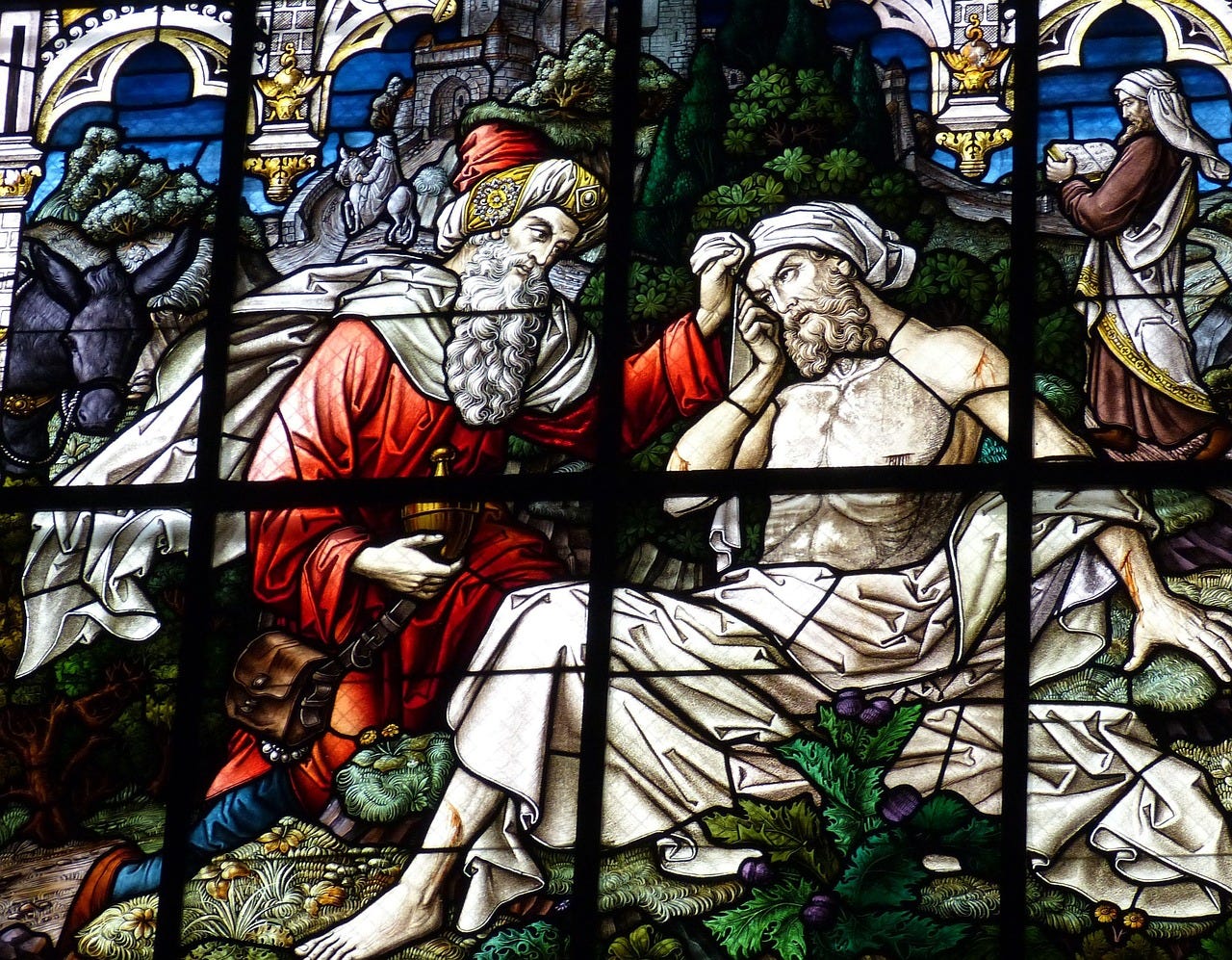
A good lawyer never asks a question he doesn’t already have an answer to.
So when the scholar of the law stands up to test Jesus, we should assume he knows the terrain. He asks what he must do to inherit eternal life, and when Jesus hands the question back to him, he answers it correctly and without hesitation: love God, and love your neighbor as yourself. He has the catechism cold.
Then comes the second question, and it gives him away.
“And who is my neighbor?”
It sounds like a request for clarification. It is really a request for a boundary.
We ask this kind of question more often than we like to admit. Not in those words, of course. We ask it when we want to know how much we are actually on the hook for. Where the obligation ends. Which people belong to the circle of those I must love, and which people I am permitted, quietly and with a clear conscience, to leave outside it. The lawyer is not asking Jesus to expand his heart. He is asking Jesus to help him draw a line.
And here is the thing worth noticing: every line that includes also excludes.
This is where the parable stops being a tale about kindness on a dangerous road and becomes something closer to a diagnosis. Because the drawing of that line, who is in, who is out, who counts as one of us and who does not, is the oldest and most dependable way human communities have ever organized themselves. We know who we are largely by knowing who we are against. Identity borrows its clarity from opposition. The neighbor and the rival often emerge from the same act of distinction.
René Girard spent a lifetime showing how this works. Human beings are imitative creatures; our desires, loyalties, and fears take their shape from one another. And when tension accumulates, as it always does, communities find their stability by agreeing, often without ever saying so, on who does not belong. The outsider absorbs the friction. The group is reconciled at his expense. The question “who is my neighbor?” carries, folded inside it, the far more interesting question the lawyer would never ask aloud: who is not?
Jesus does not answer the question that was asked.
Instead He tells a story in which the categories the lawyer is counting on quietly fall apart. A man is beaten and left half-dead in a ditch. A priest passes by. A Levite passes by. These are the insiders, the men whose whole identity is bound up with knowing where the lines are drawn. They keep their distance. Whatever their reasons, the effect is the same: the man in the ditch has fallen outside the circle of obligation, and they walk on.
Then comes the Samaritan.
It is almost impossible for us to feel what that word would have done to the original audience. The Samaritan was not a neutral stranger. He was the wrong kind of worshipper, the heretic cousin, the near enemy, precisely the sort of figure a community keeps outside its line in order to know itself. He was, in the most exact sense, the rival. If anyone in the story were a candidate to be blamed, excluded, or passed over, it was him.
And he is the one who stops.
He is the one who crosses the road, binds the wounds, pays the innkeeper, and promises to return. He does the one thing the whole sacrificial logic of in-and-out is designed to prevent: he refuses to ask whether the man in the ditch belongs to his group. He simply sees a human being who has been left for dead, and he answers.
Then Jesus turns the lawyer’s question inside out. He does not ask, “And which of these three men qualified as a neighbor?” He asks, “Which of these three was neighbor to the man who fell among robbers?”
The lawyer had asked who counts as the object of love, who is worth the trouble. Jesus answers with who became the subject of it. Neighbor is not a category you sort people into. It is something you become.
And notice the lawyer’s reply. He cannot bring himself to say the word. He does not say, “The Samaritan.” He says, “The one who showed mercy.” Even in the moment of getting the answer right, the old line is still there, still pulling, still making certain words hard to pronounce.
Go and do likewise.
We tend to hear that as a call to be kinder, and it is. But underneath the kindness is something harder. The parable does not merely ask us to help the stranger in the ditch. It asks us to recognize that the person we have placed outside our line — the rival, the wrong sort, the one we define ourselves against — may be the very one God hands us as a neighbor. And it asks us to consider that we ourselves, on our worst days, are the priest and the Levite, keeping the line intact by walking on.
The honest version of the lawyer’s question is not “who is my neighbor?” It is “who is my rival?” because that is usually the same person, seen with fear instead of mercy.
The gospel does not abolish every distinction. It refuses to let mercy stop at the line we draw between us and them.
Mercy is what crossing the road looks like.
 | A guest post by
|
I have often wondered what the Samaritan would have done had he come across the victim while being beaten and robbed rather than after…
Beautifully said. "Mercy is what crossing the road looks like." Thanks to Rico McCahon and to The Cornerstone Forum.