What Péguy Knew
“Old France” as a Window on Scapegoating, the Lie, and the Limits of Enlightenment



“We loved the Church and the Republic together and we loved them with the same heart… and for us the whole was the new world.”
—Charles Péguy, Men and Saints, p. 55
I would not likely have read Péguy on my own; I came to Péguy through Gil Bailie’s lectures, where his poetry gets quoted with reverence and appreciation. His biography and political arc aren’t the type of entry points that normally draw me in. What changed that was Gil Bailie. Gil not only quoted Péguy—he modeled how to read him. Gil's voice gave me ears to hear, and for that I’m grateful. Without that model, I might never have seen what was buried in Old France.
When I turned to Péguy’s Old France, I wasn’t met with verse—I met a confessional prose meditation that disorients as much as it clarifies. What begins as a nostalgic essay becomes a map of mimetic formation, and then—almost imperceptibly—a revelation of scapegoating’s persistence, even in its most enlightened form.
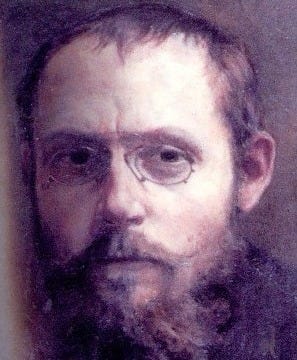
This post unpacks that movement in Old France, and then uses it as a lens to understand why even the clearest diagnoses of evil, like those in M. Scott Peck’s People of the Lie, can fall back into the very mechanism they expose. It’s also a reflection on Bandera’s critique of Girard—and why mimetic theory is not enough unless the Cross is something more than epistemology.
Charles Péguy: A Brief Introduction
Charles Péguy (1873–1914) was a French poet, essayist, and mystic whose work defies categorization. Born into poverty in Orléans—the hometown of his lifelong muse, Joan of Arc—Péguy combined Catholic spirituality, socialist ideals, and a deep reverence for labor and tradition. He began his career aligned with the radical left and the Dreyfusard cause but underwent a profound spiritual renewal around 1908, returning to Catholic belief (though not to the sacraments). His writings, especially those in his later years, reflect a unique synthesis of faith, patriotism, and moral seriousness.
He died in the first days of World War I at the Battle of the Marne, fighting for the France he had long wrestled with in prose and poetry. His legacy lives on in thinkers like Simone Weil, Gustave Thibon, and Gil Bailie, who quote him not merely for insight but for his spiritual perception.
I. A Child of Two Worlds
Péguy begins with memory. He was catechized by priests and taught by public schoolmasters. Each told him something diametrically opposed. And yet—
“We were not aware of it.” (p. 53)
This isn’t forgetfulness. It’s composite modeling: two contradictory sources, both received in affection, both absorbed into the structure of self. Péguy loved them both “with the same heart.” He was not torn between models—he was formed by them simultaneously.
At first, it seems like Péguy resolves the contradiction. He says the teachings of the catechism remained, “flesh of our flesh,” while the lessons of the secular schoolmasters faded. The Church won out.
It feels like a confession.
But then it doesn’t.
II. They Taught Us the Same Thing
A few pages later, Péguy says this:
“They taught us the same thing… this stupid morality, which has made France and which today still prevents her from going to pieces.” (p. 59)
The contradiction dissolves. The Church and the Republic, far from being opposites, turn out to have shared the same moral imaginary. What they both passed on was not metaphysics but a civil religion of labor, duty, and invisible exclusion.
“This fixed idea of our solitude, we inherit it from them all.”
This is the heart of the essay: what was inherited was not belief but loneliness. Not truth, but a myth that functioned. A moral vision that held France together—but not without cost.
It’s tempting to stop here and admire the complexity. But what happens next is more revealing.
III. The Return of the Scapegoat
As Péguy reflects on the collapse of that shared morality, he shifts. The Church and Republic fade from view. What remains is poverty—now unable to sustain life.
And so he turns to blame.
Not foreigners. Not priests. Not teachers.
The rich.
It is more acceptable. It feels more just. But it’s still scapegoating. It’s still a moral system that organizes itself around an excluded party. The “stupid morality” has not been replaced; it has been updated.
The mechanism returns.
Peck and the Lie of the Enlightened
M. Scott Peck’s People of the Lie is one of the most powerful moral books of the last century. He sees what many do not: that evil often consists in projection, in the refusal to suffer guilt, and in casting that guilt onto others—especially within families.
“A predominant characteristic… of those I call evil is scapegoating.”
But then Peck himself scapegoats the scapegoaters.
There is no way out in his system—only exposure. Those who scapegoat are “evil.” The rest of us see clearly. His readers are among the enlightened. The Lie is named, but repeated in reverse.
This is not a moral failure. It is a structural vulnerability of mimetic awareness without grace.
Suppose Peck demonstrates how those aware of scapegoating can still fall into the trap. In that case, Cesáreo Bandera shows why even Girardian awareness, if treated as merely intellectual, is vulnerable to the same fate.
Bandera and the Problem with “Understanding”
Cesáreo Bandera, in The Truth of Mankind, offers a gentle but serious critique of how some readers have approached Girard. His concern is not with Girard’s anthropology, it’s with how easily it becomes a secular tool, a lens, a diagnosis.
When the Cross is treated as the moment humanity realized it had been scapegoating all along, Christ becomes:
The most lucid victim,
The first one to see clearly,
A kind of sacrificial whistleblower.
And salvation becomes: understanding what happened.
But if that’s all the Cross is—then we’re back with Péguy’s priests and schoolmasters. We’ve traded one “stupid morality” for another—one based on clarity, exclusion of the unclear, and the moral solitude of the enlightened.
Péguy’s Gift: Seeing the Loop
The genius of Old France is not in Péguy’s conclusion, it’s in his reluctant unveiling. He doesn’t solve the mimetic contradiction. He names it, then relives it, then names that.
He tries to confess and ends up scapegoating. He tries to unify and ends up dividing. He sees and still clings.
That’s us.
The truth is: even mimetic insight cannot save us from the mimetic trap.
And grace is not a mechanism. It is not a structure. It is not an epistemology.
It is a person.
Final Word
We see, resolve to change, and in doing so, return to a more acceptable scapegoat, identical to the problem we originally saw, but now we do not see for now.
This is why Péguy, Peck, and Bandera belong in conversation.
And it’s why mimetic theory, as powerful as it is, is not enough (and I say that as someone who has seen the world through the lens of mimetic theory for nearly twenty years—it is not the only lens, but it has been the most consistent and persistent one for me).
Not because it’s wrong.
But because what’s damaged in us is deeper than just knowledge can reach.
 | A guest post by
|
Thank you for this helpful articulation of the insuficiancy of knowledge, even the amazing knowledge that comes from Girard (and others like Gil Bailie). Perhaps it is ultimately a message to our ego to remind us that we can’t save ourselves and to humble ourselves before God.