
Standing Before the Feast
Babette's Feast and John 6


One of the most remarkable details in Babette’s Feast by Isak Dinesen is that the meal itself is not enough.
Babette prepares a feast of extraordinary beauty and generosity. Yet many of the guests arrive determined not to receive it. They agree beforehand that they will not discuss the food. They will not dwell on the wine. They will endure the meal rather than enter into it. They will, in a word, tolerate it
Their resistance is subtle. They are not hostile to Babette. They are not mocking her gift. If anything, they are trying to remain faithful to what they believe. Yet their very effort to preserve themselves prevents them from receiving what has been given.
One reason I find myself thinking about them this week is that Catholics throughout the world will hear John 6 proclaimed at Mass this Sunday.
“I am the living bread that came down from heaven.”
The crowd hears Him. They understand the words well enough to be scandalized. But they cannot receive what He is offering. They immediately begin asking how such a thing could be possible. Later in the chapter, many disciples turn away altogether. They couldn’t even tolerate the teaching.
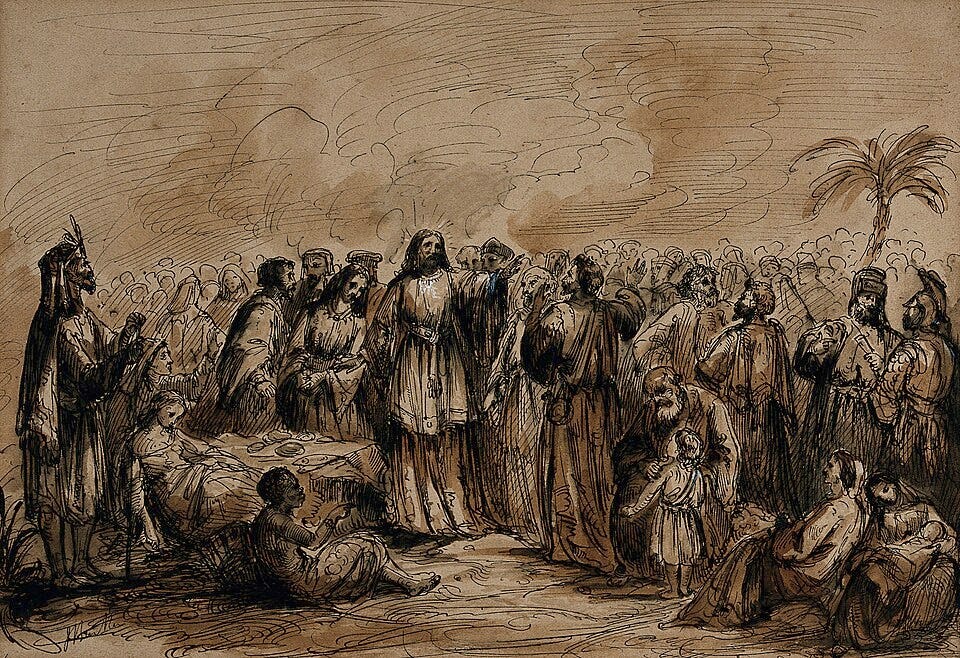
The tragedy is not that the bread was unavailable. The tragedy is that so many stood before the feast and could not taste it. Or worse, would not taste it.
Perhaps this is because we never approach Christ as blank slates. We come carrying habits of thought, fears, expectations, loyalties, and disappointments. We come with what I have elsewhere called a composite model—a lifetime of influences that shapes what we can recognize and receive, both what we desire and reject.
Sometimes those influences help us receive a gift. Sometimes they make reception difficult. (I need to get back to Augustine’s Confessions to explore that more deeply.)
The villagers in Babette’s Feast possess the form of a religious life, but they have become suspicious of abundance. Suspicious of beauty. Suspicious, perhaps, of joy itself. The crowd in John 6 possesses the Scriptures, but they cannot imagine that God would give Himself in the way Jesus proposes.
In both cases, the gift is present. The problem lies elsewhere.
General Löwenhielm serves an important role in the story because he recognizes what is happening. He has acquired the language necessary to interpret the feast. While others merely consume the meal, he receives it. He sees the gift behind the food and wine.
That distinction may be worth remembering as Catholics approach the Eucharist.
Every Sunday we stand before a feast greater than Babette’s. Christ offers not merely excellent food or drink but His very life. The question is not whether He gives Himself. The question is whether we have become the sort of people capable of receiving Him.
The soil matters as much as the seed.
The guests in Babette’s dining room were eventually softened by grace. Old grievances were released. Long-held resentments lost their grip. Communion emerged where division had once existed.
Perhaps that is one reason the story continues to resonate. It reminds us that receiving a gift is not always easy. Sometimes the greatest obstacle to communion is not the absence of grace but our inability to recognize it when it arrives.
Like the guests at Babette’s table, and like the crowd in John 6, we may find ourselves standing before a feast.
The question is whether we are willing to receive it.
Also, I need to read Babette’s Feast in full again.
 | A guest post by
|
“The soil matters as much as the seed.”
Beautiful parallel drawn. Also, I need to read Babette’s Feast in full, too.